
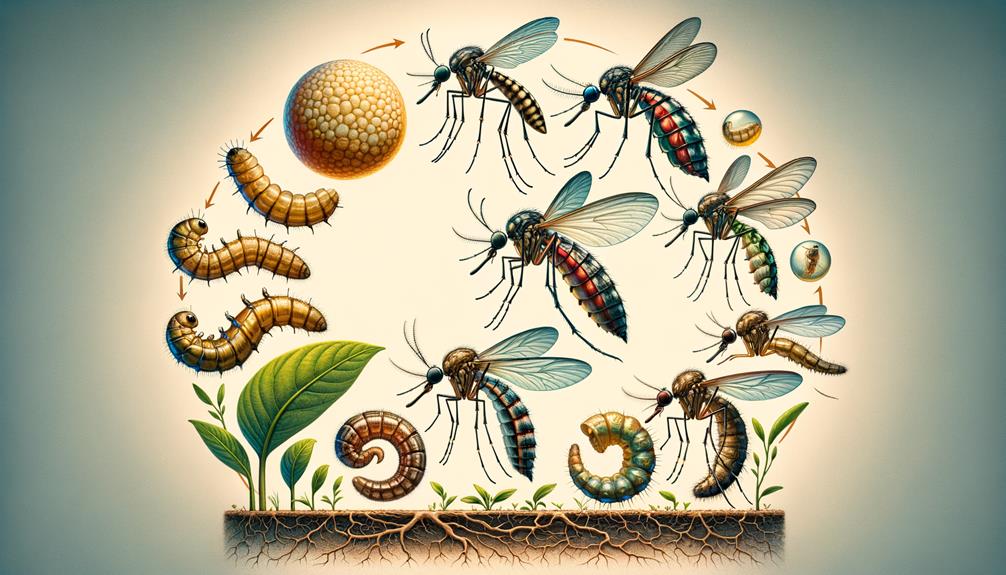
Begin a journey through the life stages of mosquitoes and learn why understanding their development is essential for effective population management. A female mosquito requires a blood meal to lay eggs, resulting in larvae hatching in water. Larvae undergo molting before transitioning into pupae and eventually emerging as adults.
Understanding how these insects develop can help homeowners identify conditions that contribute to mosquito activity and take proactive steps to reduce breeding opportunities. Companies like Nature Guard Pest & Lawn provide professional solutions designed to help manage pest populations and create more enjoyable outdoor spaces.
Key Takeaways
- Mosquito life cycle: egg, larva, pupa, adult stages.
- Female mosquitoes need a blood meal to lay eggs.
- Larval stage crucial for population control.
- Pupal metamorphosis to aerial adults.
- Environmental factors impact development.
Mosquito Life Cycle Overview
The mosquito life cycle, comprising four distinct stages – egg, larva, pupa, and adult – unfolds with remarkable precision and adaptation to aquatic environments. Female mosquitoes play a pivotal role in this cycle, needing a blood meal to lay eggs. The process begins with the female mosquito laying eggs in water, which hatch into larvae within a few days. Larvae are aquatic and go through multiple molts before transforming into pupae. Pupae don’t feed but instead undergo metamorphosis, preparing to emerge as adult mosquitoes. Once their body parts have hardened, adult mosquitoes take to the air.
Each stage in their life cycle serves a specific purpose in ensuring the survival and reproduction of these insects. Understanding these stages is essential in controlling mosquito populations and preventing the spread of diseases they may carry. The entire life cycle, from egg to adult, typically spans about two weeks, highlighting the rapid reproductive capacity of these pests in suitable environments.
Mosquito Egg Development
To optimize their reproductive success, female mosquitoes strategically deposit their eggs in sites conducive to hatching and larval development. The eggs are typically laid in rafts, floats, or on land that’s likely to flood, guaranteeing a water source for hatching.
Female mosquitoes can lay hundreds of eggs at a time, increasing the potential for a large population. These eggs possess the remarkable ability to survive dry conditions, allowing them to remain viable until suitable hatching conditions arise.
The choice of egg-laying sites near water bodies is vital, as it ensures a suitable environment for larvae to develop. The location where mosquito eggs are deposited plays a significant role in the development and survival of larvae, ultimately affecting mosquito population dynamics in a given area.
Larval Mosquito Growth
During the larval stage, mosquitoes undergo multiple molts as they develop in aquatic environments. Larvae, commonly referred to as wigglers, rely on these moltings to grow and develop. As they inhabit water bodies, larvae exhibit unique breathing mechanisms. They either utilize snorkel-like siphons to access air at the water’s surface or position themselves horizontally to extract oxygen from the water. This adaptation facilitates their survival and growth during this critical stage of the mosquito life cycle.
Effective larval control is essential in Integrated Mosquito Management strategies. Larvicides play a crucial role in targeting and diminishing larval mosquito populations, thereby curbing the number of adult mosquitoes that can emerge. By focusing on larval growth and employing larval control measures, it’s possible to disrupt the mosquito lifecycle and reduce the overall population in a given area.
Pupal Mosquito Transformation
During their metamorphosis from pupae to adults, mosquitoes undergo a substantial physiological transformation within their protective casings. Pupal mosquitoes, also known as tumblers, are in the stage just before emerging as adults. They don’t feed and are motile, able to move in water. Pupae are highly sensitive to environmental conditions, reacting to changes in temperature, light, and nutrient availability.
This stage is pivotal in their life cycle, as it marks the shift from aquatic larvae to aerial adults. Inside their protective casings, pupae undergo a remarkable transformation in which their bodies develop structures necessary for adulthood, such as wings and specialized mouthparts for feeding. Understanding the pupal stage is essential for controlling populations, as disrupting this stage can significantly reduce adult mosquito numbers and reduce the spread of the diseases they carry.
Adult Mosquito Characteristics
Emerging from their pupal casings, adult mosquitoes exhibit distinct characteristics essential for their survival and reproduction. Female mosquitoes, requiring a blood meal to lay eggs, are the ones responsible for biting humans. Once their body parts have hardened, adult mosquitoes emerge onto the water’s surface and take flight, ready to seek out a host. Understanding these characteristics is vital for implementing effective mosquito control strategies.
Let’s explore the specific features in the table below:
| Characteristic | Description |
|---|---|
| Female Mosquitoes | Require a blood meal to lay eggs, often seeking out humans as hosts |
| Body Parts | Harden after emerging from the pupal stage, enabling flight and feeding |
| Adult Lifespan | Can live from 4 days to 2-4 weeks, varying by species and environmental factors |
Environmental Factors Impacting Mosquitoes
Considering the intricate interplay between temperature, humidity, and food availability, the environment profoundly influences the life cycle dynamics of mosquitoes. Environmental factors play a vital role in shaping mosquito populations and their behaviors. Here are some key points to understand how environmental factors impact mosquitoes:
- Temperature: Mosquito development is influenced by temperature, with warmer temperatures often accelerating their life cycle.
- Humidity: Adequate humidity levels are essential for egg survival and larval development.
- Food Availability: The availability of suitable food sources, such as nectar for adult mosquitoes and organic matter for larvae, directly impacts their growth and reproduction.
- Climate Change: Shifts in climate patterns, including milder winters, can lead to earlier mosquito emergence and extended breeding seasons.
- Overwintering: Mosquitoes have adaptations that enable them to survive harsh freezes, ensuring their persistence across various environments.
Understanding these environmental factors is critical for effective mosquito population control strategies, especially in the context of climate change.
Mosquito Lifespan Considerations
In understanding mosquito lifespan, variation in longevity among species and the influence of environmental factors play significant roles. The lifespan of adult mosquitoes can range from a mere 4 days to 2-4 weeks.
Environmental conditions greatly impact the development stages of a mosquito’s life cycle. Favorable conditions, such as warm temperatures and standing water, can accelerate the progression from egg to adult, increasing the overall mosquito population. Additionally, milder winters contribute to higher mosquito populations in the spring, as some mosquitoes can overwinter successfully, even enduring harsh freezes.
Understanding these factors is vital in devising effective strategies for mosquito population control. By recognizing the impact of environmental factors on mosquito lifespan and development, researchers and policymakers can work towards implementing targeted measures for pest control.
Strategies for Mosquito Population Control
To effectively control mosquito populations, it’s imperative to implement a combination of targeted strategies that eliminate breeding sites and use regular control treatments. Mosquitoes breed in standing water, and even small sources like the bases of potted plants can produce hundreds of mosquitoes. Hiring pest control professionals for larger breeding areas can help manage populations effectively. Regular mosquito control treatments, along with the removal of standing water, are key strategies for population control. By removing standing water, not only can mosquito populations be reduced, but the risk of mosquito bites can also be significantly lowered.
- Eliminate breeding sites, such as standing water, to control mosquito populations effectively.
- Small sources of standing water, like potted plant bases, can breed hundreds of mosquitoes.
- Hiring pest control professionals for larger breeding areas can help in managing populations.
- Regular mosquito control treatments, combined with the removal of standing water, are key strategies for control.
- Removing standing water is crucial in preventing mosquito bites and breeding.
Frequently Asked Questions
What Is the Life Cycle of Mosquito Theory?
In the life cycle of a mosquito, you witness the marvel of insect metamorphosis. Larvae grow, pupae transform, and adults emerge. Breeding habitats play an essential role in this intricate process, shaping mosquito development.
What Is the Natural Enemy of the Mosquito?
Dragonflies, fish like Gambusia and Koi, birds such as Purple Martins, Swallows, bats, spiders, frogs, and predatory insects all play essential roles as natural enemies of mosquitoes. Predator-prey relationships contribute to ecosystem balance through biological control methods.
At What Stage in the Life Cycle of the Mosquito They Are Considered Harmful?
In the life cycle of mosquitoes, the critical stage when they pose a risk due to biting behavior and disease transmission occurs when they reach adulthood. Understanding this significant phase is key for effective control methods.
How Can We Break the Life Cycle of the Mosquito?
To break the mosquito life cycle, you must focus on prevention methods like eliminating standing water. Environmental factors play a role in their reproduction cycle. Control larvae, destroy habitats, and address disease transmission to effectively reduce populations.
Contact Nature Guard Pest & Lawn Today!
Understanding the mosquito life cycle is an important first step, but reducing mosquito activity around your home often requires a proactive approach. Standing water, shaded areas, and favorable environmental conditions can all contribute to increased mosquito populations, making professional guidance valuable for long-term management.
Nature Guard Pest & Lawn offers professional pest control services throughout Northwest Arkansas, helping homeowners identify breeding areas, reduce conducive conditions, and implement targeted treatments to improve outdoor comfort. Our experienced team can assess your property and recommend solutions tailored to your specific needs.
In addition to mosquito services, Nature Guard Pest & Lawn provides comprehensive protection for a wide range of common household invaders, along with lawn care programs designed to help keep your property looking its best year-round.
Looking for a trusted local provider? Check out our Google reviews and see why your neighbors trust our services. Nature Guard Pest & Lawn is proud to maintain a 4.9-star rating with 700+ reviews. This feedback reflects our commitment to responsive service, knowledgeable technicians, and customer satisfaction.
Ready to enjoy your outdoor spaces with fewer mosquitoes? Contact Nature Guard Pest & Lawn today to schedule an inspection, learn more about our mosquito reduction programs, and take the next step toward a more comfortable yard for your family and guests.